
A Manifestation Vision Board sounds like something a life coach sells you in a weekend retreat — but hear me out before you write it off. I built my first one on a random Sunday with magazine cutouts and a glue stick, zero expectations, and three of those goals showed up in my life within a year. Coincidence? Maybe. Am I taking it down? Absolutely not. 🙂
Let me walk you through everything — what a manifestation vision board actually is, why it works, and how to build one that doesn’t just collect dust behind your bedroom door.
What Is a Manifestation Vision Board (And Why Should You Care)?
A manifestation vision board is a physical or digital collection of images, quotes, and affirmations that represent the life you want to create. Think of it as a visual contract between you and your future self.
The concept is rooted in the Law of Attraction — the idea that focusing your mind on what you want helps you move toward it. But here’s the thing: it’s not just woo-woo stuff. Neuroscience backs this up. When you repeatedly visualize a goal, your brain starts treating it as a familiar reality, making you more likely to take aligned action.
In short, a vision board rewires how your brain prioritizes your goals. Not magic — just neuroscience wearing a glittery collage jacket.
Science Behind Visualization (Yes, There’s Actual Science)
Before you roll your eyes, hear me out. Visualization isn’t just daydreaming in a fancy outfit.
Research in sports psychology has shown that mental rehearsal activates the same neural pathways as physical practice. Athletes use this all the time. When you visualize a goal vividly and repeatedly, your brain starts building pathways that support that goal becoming real.
Here’s what vision boards do on a practical level:
- They program your Reticular Activating System (RAS) — that’s the filter in your brain that decides what gets your attention. Tell your brain what matters, and it starts spotting opportunities you’d have previously missed.
- They keep your goals visible — out of sight, out of mind is real. A board you see daily keeps your dreams front and center.
- They create emotional anchors — visuals trigger feelings, and feelings drive decisions. Simple as that.
So no, you don’t need to believe in the universe whispering in your ear. You just need to believe in your own brain’s ability to focus.
What You Need to Get Started
Great news: this doesn’t require a massive budget. Here’s your manifestation vision board supply list:
For a Physical Board:
- A corkboard, poster board, or foam board
- Old magazines, printed images, or photos
- Scissors and glue/tape
- Markers, pens, or stickers for affirmations
- Optional: washi tape, stickers, paint for decoration
For a Digital Board:
- Canva (free version works perfectly)
- Pinterest boards (quick and easy)
- Google Slides or PowerPoint for a structured layout
- Apps like Vision Board: Dream Visualizer
IMO, physical boards hit different — there’s something about cutting and arranging things with your hands that makes it feel more intentional. But digital works great if you want it accessible on your phone 24/7.
Step-by-Step: How to Create Your Manifestation Vision Board
Step 1: What You Actually Want
This is the most important step, and most people rush it. Don’t.
Before you touch a single magazine, sit down and write out your goals across the major areas of your life. Think about:
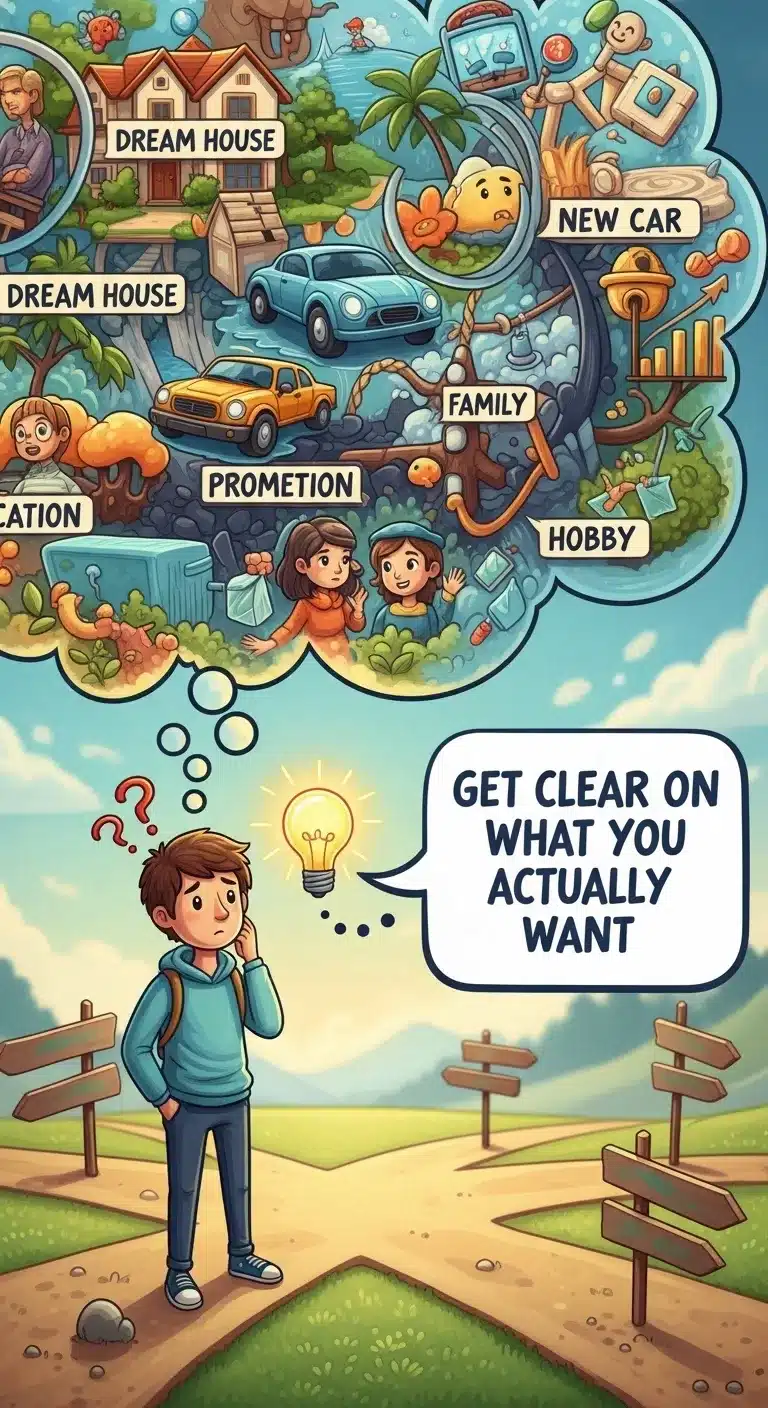
- Career & finances — Where do you want to work? What income feels right?
- Relationships — What kind of partner, friendships, or family life do you want?
- Health & wellness — How do you want to feel in your body?
- Personal growth — What skills, experiences, or traits do you want to cultivate?
- Lifestyle & travel — Where do you want to live, travel, or spend your time?
Be specific. “I want to be successful” is too vague for your brain to latch onto. “I want to earn $80k a year doing creative work I love” gives your RAS something to work with.
Step 2: Spark Genuine Emotion
Here’s where people go wrong: they pick images that look inspiring rather than images that feel inspiring. Big difference.
When you flip through magazines or scroll through Pinterest, look for visuals that give you a gut reaction — that little jolt of “yes, that’s it.” Those are the ones to use.

Good sources for vision board images:
- Magazines (travel, fitness, interior design, business)
- Printed photos from your own life
- Pinterest boards (search your dream aesthetic)
- Free stock photo sites like Unsplash or Pexels
- Screenshots of places, people, or ideas that excite you
Pro tip: don’t overthink the aesthetics. A messy, emotion-packed board beats a beautiful, hollow one every single time.
Step 3: Include Powerful Affirmations and Quotes
Images set the vision; words anchor the belief. This is where affirmations come in.
Write or print out short, present-tense statements that describe your goals as if they’re already happening. For example:
- “I am confident, healthy, and thriving.”
- “I attract abundance in every area of my life.”
- “I am living my dream career.”
Also include quotes that resonate with you — from books, songs, people you admire. The key is that every word on that board should feel true in your gut, even if it’s not yet true in your current reality.
Step 4: Arrange and Assemble Your Board
Now the fun part. Lay out all your images and words before you glue anything down.
A few layout tips:
- Center your most important goal — your eye naturally gravitates to the middle, so put your biggest dream there.
- Group by life category — it creates a cleaner visual and helps your brain organize the vision.
- Leave some breathing room — a cluttered board is visually overwhelming, which is the opposite of what you want.
- Add your own photo — putting yourself on the board (literally) reminds your brain that you are the person living this life.
Once you’re happy with the arrangement, glue or pin everything in place. Add any final decorations, borders, or written notes. Make it yours.
Step 5: Place It Where You’ll Actually See It
A vision board hidden in a drawer does absolutely nothing. You need to see it every single day.
Popular placement ideas:
- Above your desk or workspace
- On your bedroom wall facing your bed (the first thing you see in the morning)
- As your phone or desktop wallpaper (if digital)
- Inside your journal or planner
The goal is daily exposure. The more often your brain encounters these images, the more it treats them as part of your normal reality.
How to Use Your Vision Board Daily (Not Just Once)
Making the board is step one. Using it consistently is where the real work begins. FYI, most people who “tried a vision board and it didn’t work” looked at it twice and forgot about it.
Here’s a simple daily vision board practice:
- Morning check-in (2–5 minutes) — Look at your board when you wake up. Let each image or affirmation sit with you for a moment. Feel the emotion it’s meant to evoke.
- Visualization session — Close your eyes and imagine yourself living the life on that board. Be specific. What do you see, hear, smell? The more vivid, the better.
- Aligned action — Ask yourself: what’s one small thing I can do today that moves me toward one of these goals? Then do it.
This three-step loop is what separates people who see results from people who just have pretty boards on their walls.
Common Vision Board Mistakes to Avoid
Let’s talk about what doesn’t work — because knowing the pitfalls saves you a lot of time.
- Being vague — “Happiness” is not a goal. A specific experience or feeling is.
- Including others’ dreams — Put only things you genuinely want, not what looks impressive to other people.
- Forgetting to revisit — Life changes. Update your board at least once a year.
- Skipping the action part — A vision board is a compass, not a magic lamp. You still have to walk toward what you want.
- Making it too cluttered — If everything is loud, nothing stands out. Curate ruthlessly.
Digital vs. Physical Vision Boards: Which One Is Better?
Honestly? The best vision board is the one you’ll actually use. But here’s a quick breakdown:
Physical boards:
- More tactile and intentional in creating
- Always visible in your space
- Great for home-based goals (lifestyle, relationships, home)
Digital boards:
- Portable and always with you
- Easy to update and reorganize
- Perfect for people who spend a lot of time on screens
Some people keep both — a physical one at home and a digital version as their phone wallpaper. That’s a solid strategy. :/ (Too extra? Nah.)
When to Make a New Vision Board
Most people make a new board once a year — January is popular for obvious reasons. But you can make one anytime a major shift happens:
- After a breakup or a new relationship
- Starting a new job or business
- Moving to a new city
- A major personal decision or life transition
FAQs
1. How long does it take for a vision board to work?
There’s no universal timeline — and anyone who gives you a specific number is guessing. Some people notice shifts within weeks, others within months. What matters more than time is consistency. If you’re looking at your board daily, taking aligned action, and genuinely believing in your goals, you’ll tend to see results faster. Think of it less like a timer and more like a habit — the longer you stick with it, the more it compounds.
2. Does it matter what size my vision board is?
Not really — size doesn’t determine effectiveness. A small A4 board you see every morning beats a giant poster you shove in a corner and forget. That said, bigger boards do give you more room to organize goals by category, which can make the whole thing feel less cluttered and more intentional. Pick a size that fits naturally in a spot you genuinely look at every day, and you’re already doing it right.
3. Can I put other people on my vision board?
You can include people who inspire you — a mentor, an athlete, a public figure whose energy or lifestyle resonates with you. What you want to avoid is putting specific real people in romantic or personal roles, like pasting your crush’s face next to “my future partner.” That shifts the focus from your growth to controlling someone else’s choices, which is both ineffective and uncomfortable. Keep the board about the life you want to build, not about specific people filling specific roles.
4. Should my vision board only have things I don’t have yet?
Not necessarily. Including things you’re already grateful for — a friendship, your health, a skill you’ve built — is actually a powerful move. It trains your brain to recognize abundance in your current life, which makes it easier to attract more of it. A mix of current gratitude and future goals tends to feel more emotionally authentic than a purely aspirational board. It also stops the board from feeling like a constant reminder of everything you lack.
5. Is a digital vision board as effective as a physical one?
Yes — if you actually look at it. The effectiveness comes from consistent exposure and the emotional response it triggers, not the medium. Digital boards win on convenience and portability, while physical boards tend to feel more intentional to create and are harder to ignore when they’re hanging on your wall. If you spend a lot of time on your phone or laptop, a digital board set as your wallpaper might actually get more daily eyeballs than a physical one. Go with whatever format fits your lifestyle.
6. Do I need to keep my vision board private?
You don’t have to, but there’s a good reason many people choose to. Research on goal-sharing suggests that telling people about your goals can sometimes trick your brain into feeling like you’ve already achieved them — reducing your drive to actually follow through. Keeping your board private protects the energy around your goals while they’re still in progress. That said, sharing with a close, supportive person who will hold you accountable can work in your favor. Use your judgment based on who’s in your circle.
Ready to build yours? Start with one goal. One image. One word that makes you feel like you’re already there. The rest follows.
Read More:
- Spiritual Meaning of Being Pregnant in a Dream
- Spiritual Meaning of Feeding a Baby in a Dream?
- Spiritual Meaning of Menstruation in a Dream
- 5 Spiritual Meaning of Losing Shoes in a Dream
Final Thoughts
Here’s my take: whether or not the universe literally “sends” you things is beside the point. What’s undeniable is that clarity of vision changes your behavior. When you know what you want, you make better decisions, notice more opportunities, and show up with more energy and intention.
A vision board is just a tool that helps you stay focused on what matters. It’s not a substitute for hard work — it’s the thing that makes the hard work feel worth it.
So grab a magazine, fire up Canva, or just open Pinterest. Your future self is waiting to be visualized.